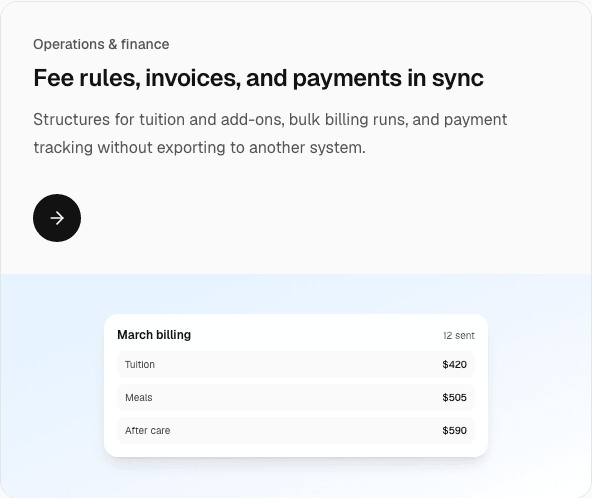

A swim parent buys “eight lessons.” A dance parent buys “twice a week this term.” An adult boxer pays “unlimited this month” and expects the desk to know. Those are three different offers. If they all live as rows in a spreadsheet, the front desk becomes a calculator, and the family becomes the auditor.
Classroom treats studio money as part of the same workspace as the class. Studios run in Learning centre mode. There is no separate activity onboarding and no second billing app you export into on Sunday night. Preschools on the same product still define tuition and fees — meals, transport, and the monthly care bill. That preschool fee pattern is labeled below so a studio does not copy it by accident. Studio offers are class packs and memberships.
Published plan prices do not change with the offer you sell. Free, Starter at RM 99, Professional at RM 199, and Enterprise from RM 2,300 are the Classroom subscriptions. What you charge a family for lessons is your price, in your currency. Organisation currency covers programme fees and invoices. It does not rewrite the Classroom subscription, which stays in ringgit on pricing.
Three offers, and when each one fits
The product names three kinds of lesson package. Use the one that matches the sentence you already say at the desk.
Class pack. A set number of lessons, with a validity in months. Eight lessons, valid for three months, is a pack. It suits beginners, intro courses, and families who will not commit to a calendar month. When you assign the pack, the balance is a count of lessons, not a vague “they’re paid up.” Attendance is what makes the count honest. A lesson that is never marked still looks unused.
Monthly unlimited. A membership for people who come often enough that counting cards is theatre. Adult boxing, a dance open practice that is truly open, or a swim squad that trains most days can sit here. “Unlimited” means the offer does not tick down a lesson balance. It does not mean the room has no cap. Capacity still lives on the class. A full lane is full even when the swimmer’s membership is unlimited.
Classes per week. A membership with a number attached: one, two, or three sessions each week. This is the dance-school default and a common swim-school default. The family is not buying a countdown card, and they are not buying the right to appear in every session you run. They are buying a weekly rhythm. Pair it with one weekly time when they must pick Monday 4pm or Wednesday 4pm rather than both. If your schedule style is “every weekly time of the group,” a classes-per-week promise and the calendar will argue. Pick one story.
You can sell more than one kind. A studio often keeps a pack for trials-that-converted and a membership for people who stay. What fails is selling all three to the same person in the same week without writing down which one the invoice is for.
Assign the offer to the person, not to the chat thread
A package that exists only as a menu item has not been sold. Assign it to the member. The assignment is what ties the invoice, the class, and the person together.
For a child, the parent is the usual invoice recipient. For an adult who trains and pays for themselves, the recipient is the self-payer. They sign in with the email and phone you collected, and class-pack invoices go to them. Do not create a fake parent record to satisfy a preschool form. Parent and emergency-contact requirements at create are preschool only. Learning centre lets you add the person and complete the portal login without pretending an adult boxer has a guardian.
When the assignment needs an invoice, Classroom can draft one. The draft should show the offer name, the count or the weekly allowance, and the amount. Send it from the same system that will later show “paid.” Recording the payment on the invoice is what stops the desk and the parent from keeping two versions of the truth. A longer look at reminders and recorded payments, including preschool tuition, is in tuition and invoicing.
Validity is part of the pack, not a footnote. If eight lessons expire in three months, the expiry date should be visible before a coach promises a make-up in month four. Make-up, trial, and replacement are booking types on a session. They are how you mark an exception. They are not a fourth price list unless you decide to charge for them. Write that policy once. The studio attendance guide shows where the mark lives.
What preschool billing looks like, and why studios skip it
Preschool only: a care day is usually priced as tuition plus optional fees. Full day, half day, extended hours, meals, transport, and a late pickup charge are fee structures. They repeat because the child is enrolled for the month, not because they attended a 45-minute class. Invoices often go out in a batch for the billing period. Health logs, vaccination records, and verified pickup sit beside that bill because the family is buying care, not a lesson count.
A studio that copies that model will invent charges it does not deliver. A boxing gym does not bill “lunch.” A dance studio does not bill “nap.” If you run both a preschool and classes in one organization, keep the preschool fees on the preschool enrolment and the packs on the class enrolment. Hybrid operations exist for centres that truly do both. A pure studio stays in Learning centre mode and does not turn the preschool day on. The choice is explained in Learning centre or a preschool day.
Shared between both audiences: an invoice the family can open, a payment you can record, and a ledger that does not require an export to a second finance app. Staff on paid plans are not billed per login. The roster allowance counts enrolled children or class members, including adult self-payers.
Price the offer from the room, not from a round number
Owners often copy a neighbour’s price and then discover the room cannot hold the membership they sold. Work backwards.
Start with the session. If a lane holds six swimmers and the coach is paid for that hour, the price of a weekly slot has to cover the coach, the pool time, and a share of the desk. A pack of eight is that slot times eight, plus a small margin for the lessons people do not take before expiry. Do not hide the expiry. Families who feel tricked do not renew, and the unused lesson was never free for you — the lane still ran.
A classes-per-week membership should name the number. “Unlimited” that is secretly “twice a week” will be argued on a Saturday. Monthly unlimited should be rare enough that the room can absorb the keen ones. If every member is unlimited and every member comes to every session, you do not have a membership. You have an overcrowded class.
Discounts are a policy. A sibling rate, a second-class rate, and a staff rate are fine if they are written as offers, not as a quiet edit on one invoice. Quiet edits are how the next owner cannot explain last term’s revenue. If you need a business plan before you publish prices, the preschool version is in daycare business plan. The same arithmetic — fixed costs, occupancy, break-even — applies to a studio with lane hours instead of childcare ratios. Licensing language in that article is preschool-specific. A studio confirms coaching standards, venue permits, and insurance instead.
Invoices, reminders, and the portal
Families forgive a price. They do not forgive a surprise. The portal is where a parent or a self-payer sees the invoice, the status, and the history. Send the invoice when the pack or membership starts, not after the third class when someone asks. Reminders exist so staff are not texting “just checking” from a personal phone. Turn them on only if the due date on the invoice is a date you are willing to enforce.
Partial payments happen. Record what arrived. The remaining balance should still be visible to the person who owes it. Cash at the desk is still a payment. Write it down in the product the same day. A receipt that lives only in a shoebox will not match the portal, and the portal is what the family believes.
Refunds and freezes need a sentence in your terms before you need them. A medical freeze on a swim pack is common. A “I changed my mind after two lessons” refund is a commercial choice. Classroom can show the invoice and the attendance that supports your decision. It will not invent a refund policy you never wrote. Keep that policy next to the waiver. The waiver is one text for the organisation, signed before the first booking. It is the right place for assumption of risk. It is the wrong place to hide the price.
A termly rhythm that finance can repeat
Pick a day of the month that invoices go out, and a day that attendance must be complete so packs are trustworthy. Many studios use the last weekday before a new month. The owner looks at three numbers: packs that will expire within 30 days, memberships that did not renew, and invoices still open. Those three numbers are a retention meeting. They are also how you stop a coach from promising a free month that finance never agreed to.
Do not rebuild the price list every week in response to one complaint. Change it at a term boundary, tell families in the portal, and let the old packs run out under the terms they were sold on. Grandfathering is easier when the original offer is still attached to the person.
If you run more than one branch, the offer can be shared and the room is local. A “Beginner pack” that means eight lessons in both pools is one product. The Monday 4pm lane is not. See running a swim, dance, or boxing studio for how the class and the weekly time are set up, and multi-branch operations when a second site arrives.
What to ignore
Ignore tools that bill only a preschool month and have no lesson balance. Ignore tools that sell packs but cannot mark the session those packs pay for. Ignore a second app whose only job is “memberships” if it cannot see attendance. The export between them is where balances go to die.
Ignore the urge to put preschool daily-report fields on a studio invoice. Parents of a Saturday swimmer want the lane, the coach, the lessons left, and the amount due. They do not want a meal chart. Give them the portal. Draft the announcement that explains it, have a human send it, and retire the payment screenshot thread.
Plans stay simple while you do this. A single studio usually starts on Free to load a small roster, then Starter at RM 99 for one location and the invoicing tools. Professional at RM 199 is the step when you want a second location, payroll for coaches, or the assistant to draft renewal notes. Enterprise, from RM 2,300, is a volume conversation. None of those prices are your lesson price. They are the software. Your pack price is yours.
Frequently asked questions
What is the difference between a class pack and a membership?
A class pack is a fixed number of lessons with a validity period. A membership is either monthly unlimited or a set number of classes each week. Packs count down. Memberships describe a rhythm. Both can produce an invoice in the portal.
Can an adult buy a pack and pay for themselves?
Yes, in Learning centre mode. Add them as an adult self-payer with the email and phone they will use to sign in. They become the invoice recipient. You do not attach a parent. Parent links at create are a preschool requirement.
Do studio packs use a different Classroom plan from preschool tuition?
No. Free, Starter at RM 99, Professional at RM 199, and Enterprise from RM 2,300 are the same plans. The allowance counts the roster — enrolled children or class members — not the number of packs you define. Preschool fee structures and studio packs share invoicing. They are not the same offer.