
Report card season should not mean every teacher staring at a blank box. This list gives you 90 preschool progress report comments you can adapt—organized by developmental area—plus tips for storing comments in preschool management software when you outgrow Word docs.
Start your free trial → if you want progress reports and daily updates in one parent portal.
How to use these progress report comments
- Personalize: Swap in the child’s name and a specific example from your classroom
- Stay objective: Describe what you observed, not labels (“hit peer” vs “is mean”)
- Pair strength + growth: Balance positive notes with one clear next step
- Match your framework: Align wording with your centre’s curriculum or assessment rubric
Social & emotional development
- Shows kindness to peers and often invites others to join play.
- Is learning to share materials during group activities.
- Expresses feelings with words more often than physical reactions.
- Separates from caregivers with increasing confidence.
- Follows classroom routines with minimal reminders.
- Demonstrates empathy when a friend is upset.
- Is building turn-taking skills during free play.
- Responds well to gentle redirection from adults.
- Participates in group circle time and listens to others.
- Is developing patience when waiting for a preferred activity.
- Shows pride in completed work and enjoys sharing it.
- Manages transitions between activities more smoothly this term.
- Uses polite language (please/thank you) with peers and teachers.
- Is learning to resolve small conflicts with teacher support.
- Demonstrates growing confidence in new social situations.
Language & communication
- Uses expanded vocabulary during play and group discussions.
- Answers open-ended questions with complete sentences.
- Enjoys story time and can retell familiar stories in sequence.
- Asks thoughtful questions about topics of interest.
- Is practicing letter sounds during phonics activities.
- Recognizes several letters in their name.
- Shows interest in writing and drawing to communicate ideas.
- Follows two-step directions during classroom routines.
- Participates in songs and rhymes with enthusiasm.
- Is building listening skills during small-group lessons.
- Uses descriptive language when explaining artwork or builds.
- Engages in back-and-forth conversations with peers.
- Is developing pre-reading skills through print exposure.
- Shows progress in home-language development alongside English.
- Benefits from extra time to formulate responses—progress noted.
Cognitive & learning
- Shows curiosity and asks “why” during exploration activities.
- Persists with challenging puzzles and building tasks.
- Sorts objects by colour, shape, or size with accuracy.
- Demonstrates early counting during play (1–10).
- Makes predictions during simple science experiments.
- Focuses for longer periods during preferred activities.
- Connects new learning to prior experiences.
- Shows creativity in open-ended art and construction.
- Participates actively in themed project work.
- Is developing problem-solving strategies with minimal hints.
- Shows interest in numbers and patterns in the environment.
- Completes table activities with growing independence.
- Uses trial and error appropriately during discovery play.
- Demonstrates memory skills in matching and sequencing games.
- Is ready for slightly more complex tasks next term.
Motor skills (fine & gross)
- Shows improved pencil grip during drawing and writing.
- Cuts along lines with developing control.
- Uses scissors, glue, and tools safely with supervision.
- Demonstrates coordination on climbing and balance equipment.
- Participates enthusiastically in outdoor gross-motor play.
- Is building hand strength through fine-motor centres.
- Runs, jumps, and stops with control in open spaces.
- Shows progress in dressing skills (buttons, zippers) at school.
- Uses utensils independently during mealtimes.
- Throws and catches a ball with improving aim.
- Shows spatial awareness when moving among peers.
- Benefits from extra practice with fine-motor tools—progress seen.
- Demonstrates safe use of playground equipment.
- Is developing bilateral coordination during craft activities.
- Shows stamina during longer outdoor play sessions.
Behaviour & work habits
- Follows classroom rules with occasional reminders.
- Cleans up materials when prompted and increasingly without prompts.
- Arrives ready to learn and settles into morning routines.
- Accepts limits and boundaries in a calmer manner.
- Is learning to use a calm-down strategy when frustrated.
- Shows respect for classroom materials and peers’ work.
- Completes tasks within allotted time with support.
- Demonstrates honesty and openness with teachers.
- Responds positively to praise and constructive feedback.
- Is building consistency in daily habits (line up, wash hands).
Kindergarten readiness (end-of-year)
- Shows readiness for structured small-group instruction.
- Demonstrates independence in self-care routines.
- Follows multi-step directions in preparation activities.
- Shows interest in early literacy and numeracy centres.
- Separates from parents and engages quickly in learning.
- Works cooperatively in pairs and small groups.
- Shows appropriate stamina for a full school day.
- Uses words to solve problems before seeking adult help.
- Demonstrates curiosity suitable for the next grade level.
- Would benefit from continued practice with [specific skill] over the summer.
Short comments when time is limited
- A joy to have in class—keep reading together at home!
- Making steady progress across all areas—well done.
- Shows enthusiasm for learning—continue encouraging questions.
- Friendly and cooperative—great team player.
- Creative thinker—loves art and building.
- Growing in confidence each month.
- Pleasure to teach—thank you for your support at home.
- Keep practicing [skill]; we see improvement.
- Active participant—benefits from consistent routines.
- Ready for new challenges next term.
End-of-year vs mid-year comments
Mid-year: Focus on one strength and one growth area with a concrete example.
End-of-year: Summarize progress across domains and note readiness for the next class or kindergarten.
Avoid comparing children to peers. Reference your centre’s learning goals instead.
Store comments in preschool management software
Copy-paste lists help once a term. If your team rewrites the same phrases in spreadsheets, email, and paper report cards, centralize templates in preschool management software.
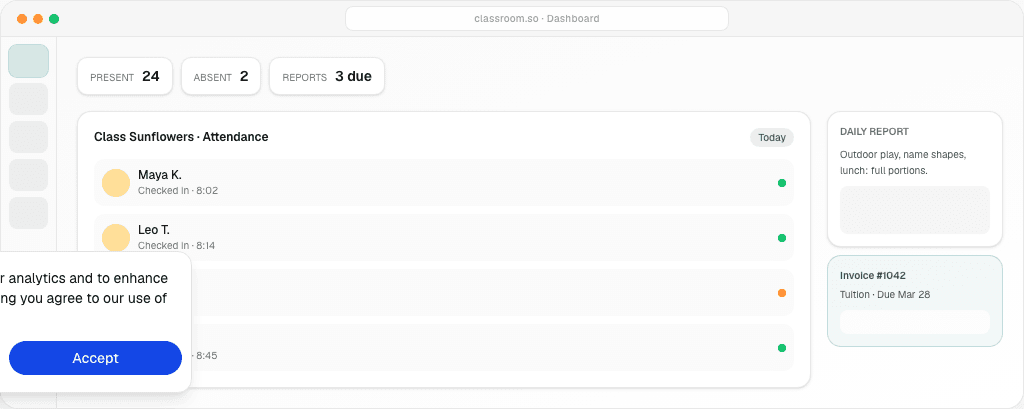
Classroom supports progress reports alongside daily reports and a parent portal—so teachers log observations during the term and publish summaries families can read on their phones.
Explore the full platform in our childcare management software guide.
Frequently asked questions
What are good comments for preschool report cards?
Good comments are specific, objective, and balanced: one observed strength, one growth area, and a supportive next step. Use the lists above as starters—always add a real example from your classroom.
How long should preschool progress report comments be?
Two to four sentences per domain is enough for most families. Shorter is fine if you also meet parents in person.
Can I automate progress reports for parents?
Yes. After teachers collect notes during the term, software like Classroom publishes progress summaries to the same portal used for daily reports and billing—reducing PDF email chains.
Save time next report season
Bookmark this page for your teaching team. When comment banks outgrow copy-paste, move progress data into one system families already trust.
Related: Daily report template · Parent communication app · Classroom vs Brightwheel