
A daycare business plan is a written plan covering market demand, services, staffing, marketing, startup costs, fee model, and break-even—so lenders, landlords, and licensing officers can evaluate whether the centre is operable and fundable.
This guide gives you a practical daycare business plan template—section by section—with cost categories directors actually use in Malaysia, Singapore, and beyond. When you are ready to run the centre, pair the plan with childcare management software so attendance, billing, and parent updates are not still on spreadsheets.
Start a free Classroom trial →
Why you need a daycare business plan
A business plan for daycare is not only for investors. It forces decisions before you sign a lease:
- How many children can you enrol safely (ratios + classrooms)?
- What monthly fee covers rent, payroll, food, and a buffer?
- How will you fill the first 20–40 seats?
- What software and processes keep parents informed without burning out teachers?
Centres that skip this step often underprice fees or overbuild classrooms.
Daycare business plan template — sections to include
Use this outline as your daycare business plan template. Copy it into a doc and fill each section with local numbers.
1. Executive summary
One page covering:
- Centre name, location, ages served
- Capacity (licensed + target enrolment)
- Fee model (monthly tuition, deposits, extras)
- Funding ask (if any) and 12-month revenue goal
2. Company description
- Legal entity and ownership
- Mission (care + learning outcomes)
- Opening timeline and licence status
3. Market analysis
- Neighbourhood demand (working parents, housing density, competitor centres)
- Age groups with waitlists nearby
- Differentiation (hours, language programme, outdoor space, parent portal)
4. Services and curriculum
- Infant / toddler / preschool / after-school
- Daily schedule sample
- Enrichment (optional)
- Parent communication cadence (daily reports, photos, conferences)
5. Operations plan
- Classroom layout and ratios
- Staffing roster by role
- Supplier list (food, cleaning, materials)
- Systems: attendance, billing, health records, pickup authorisation
6. Marketing plan
- Enrolment funnel (open house → trial day → contract)
- Channels (WhatsApp communities, Google Business Profile, partnerships)
- Retention (daily reports parents actually read)
7. Financial plan
Include:
- Startup costs (renovation, deposits, furniture, licences, software)
- Monthly fixed costs (rent, utilities, insurance, payroll)
- Variable costs (food, supplies)
- Revenue forecast at 50%, 75%, and 90% occupancy
- Break-even month
8. Risk and compliance
- Licensing and fire safety
- Health policies
- Data privacy for child records and photos
Startup cost categories (checklist)
Typical line items for a daycare business plan:
| Category | Examples | | --- | --- | | Premises | Deposit, renovation, signage | | Fit-out | Furniture, nap mats, kitchen | | Compliance | Licences, insurance, first-aid kits | | Staffing | Hiring, training, uniforms | | Operations | Software, devices, internet | | Working capital | 3 months payroll + rent buffer |
Price software as a monthly operating cost—not a one-time surprise. See preschool billing software for fee structures that match enrolment.
Operations systems to name in the plan
Investors and directors alike ask: “How will you run day two?” Name the tools:
- Digital attendance and pickup verification
- Daily reports to a parent portal
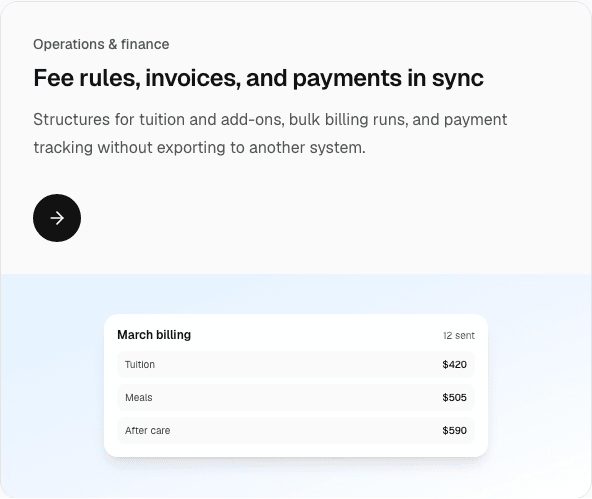
- Tuition invoices and reminders
- Multi-class or multi-branch reporting if you plan to expand
Classroom covers these in one platform—see the software guide and Brightwheel alternative comparison if you are evaluating vendors.
Sample one-year milestones
- Month 0–2: Licence, fit-out, hire lead teachers
- Month 3: Soft open with 40–60% capacity
- Month 6: Hit break-even occupancy
- Month 12: Waitlist for peak age group; review fee increase
Frequently asked questions
What should a daycare business plan include?
Cover an executive summary, company description, market analysis, services and curriculum, operations and staffing, marketing, financial projections (startup costs, fees, break-even), and compliance risks.
How detailed should daycare financial projections be?
Include startup costs, monthly fixed and variable costs, occupancy scenarios, and a break-even month. Use real rent and payroll quotes—not round-number guesses—and model fees at conservative occupancy first.
Do lenders or licensing boards require a daycare business plan?
Banks, landlords, and some regulators often ask for a written plan covering capacity, fees, staffing ratios, and compliance. Even when not required, a plan helps you decide lease size and fee levels before fit-out spend.
Related guides
- How to start a daycare
- Free daycare templates
- Childcare management software
- Best childcare management software (2026)
- Preschool daily report template
Next step
Finish the financial section with real rent and payroll quotes, then pick systems that scale with enrolment—not more spreadsheets.
Start your free Classroom trial → or review pricing.